Southern California's Full-Lifecycle Fire Protection Partner
Your building passed its last fire inspection. Your sprinkler contractor signed off on the quarterly. So why does your compliance file have three separate vendors, two outstanding deficiency notices, and nobody you can call who owns the whole picture?
This is the real fire protection problem facing commercial and industrial property managers across Southern California right now. And it is not a problem that any single specialty vendor, no matter how competent at their narrow slice, is designed to solve.
What 'Commercial Fire Protection' Actually Means
When a property manager or building owner searches for a commercial fire protection company serving Southern California, the words carry a specific implied requirement: one contractor who can design, install, inspect, test, and maintain every fire protection system in the building under a single point of accountability.
"One contractor who can design, install, inspect, test, and maintain every fire protection system in the building under a single point of accountability. That is not a luxury, it is the baseline requirement for serious multi-site compliance management."
That means fire sprinkler systems designed and installed to NFPA 13. Water-based suppression systems maintained to NFPA 25 quarterly, annual, and five-year schedules. Special hazard systems designed for the specific occupancy and hazard class. And a compliance documentation trail that holds up when the Authority Having Jurisdiction walks in.
Most fire protection contractors in Southern California handle one or two of those categories. Some are excellent at what they do within that lane. But for a property manager running four, six, or twelve locations, excellence in a narrow lane creates a coordination problem that eventually becomes a compliance gap.
The Vendor Fragmentation Problem
Here is how it typically unfolds. A building owner brings in a sprinkler contractor for a new tenant improvement. That contractor installs to code and moves on. When the annual inspection comes due, the building owner calls a service company. Sometimes the same contractor, sometimes not.
None of these parties has visibility into what the others are doing. None of them is tracking the full compliance picture across the building, let alone across a portfolio of buildings. The property manager does.
This is not a hypothetical risk. It is the compliance failure mode that produces deficiency notices, re-inspection fees, insurance documentation gaps, and in the worst cases, citations that trigger mandatory shutdowns. The cost of fragmented vendor relationships is not just administrative inconvenience. It is direct liability exposure for the property manager who signed the certificate of occupancy.
Why Southern California Adds Complexity
Commercial fire protection in Southern California is not the same as commercial fire protection anywhere else. The regulatory environment is layered in ways that catch property managers and out-of-region contractors off guard.
These are national standards, but California adopts them with state-level amendments through Title 19 and the California Fire Code, and then each county and each city within each county adds its own AHJ-specific requirements on top.
The contractor who knows your AHJ personally is worth more than the contractor who knows the national standard perfectly.
What that means in practice: a fire protection contractor who works primarily in Los Angeles County may not have the working relationships with AHJs in Riverside or San Bernardino Counties that determine whether your permit gets approved in two weeks or two months. The Inland Empire is its own regulatory environment, and it is one that has been tightening. Insurance carriers are increasingly requiring documented inspection histories and system certifications as a condition of coverage. AHJs in Riverside and San Bernardino Counties are actively enforcing, and the wildfire proximity that defines the region's risk profile is driving more rigorous scrutiny of suppression system design and coverage.
For property managers with facilities in the Inland Empire, from Temecula up through Lake Elsinore, Perris, Moreno Valley, and into the San Bernardino Basin, the contractor who knows those AHJ relationships personally is not a nice-to-have. It is a project timeline and compliance outcome.
What a Full-Lifecycle Model Looks Like
Alternative Fire Protection Service was founded in 1987 by John Geer as a fabrication shop in Lake Elsinore.
The model is not complicated to describe, but it is genuinely rare to find: single-source accountability from the first design submission through every recurring inspection cycle, with no subcontractor handoffs at any stage. In-house fabrication capability reduces lead times and eliminates the third-party dependencies that create delays on custom system components. The same team that designs your system knows what the AHJ in your jurisdiction will flag before the inspector walks in.
For multi-site property managers, that means one point of contact, unified compliance documentation across all locations, and a contractor who is actively tracking every inspection deadline and code requirement across the portfolio. Not waiting to be called when something lapses.
The current wildfire season makes this model especially relevant. Southern California's fire risk corridor runs directly through the Inland Empire, and facilities near dry brush or in wildland-urban interface zones face system design and maintenance requirements that generic contractors do not always address. Whether that means suppression coverage at building perimeters, alarm sensitivity calibration for wildfire-adjacent scenarios, or ensuring your system documentation is current before the next brush fire moves through, a contractor with 40 years of local presence and direct AHJ relationships in this specific geography is not the same as a national platform managing your account from a call center.
The Special Hazard Gap Most Contractors Miss
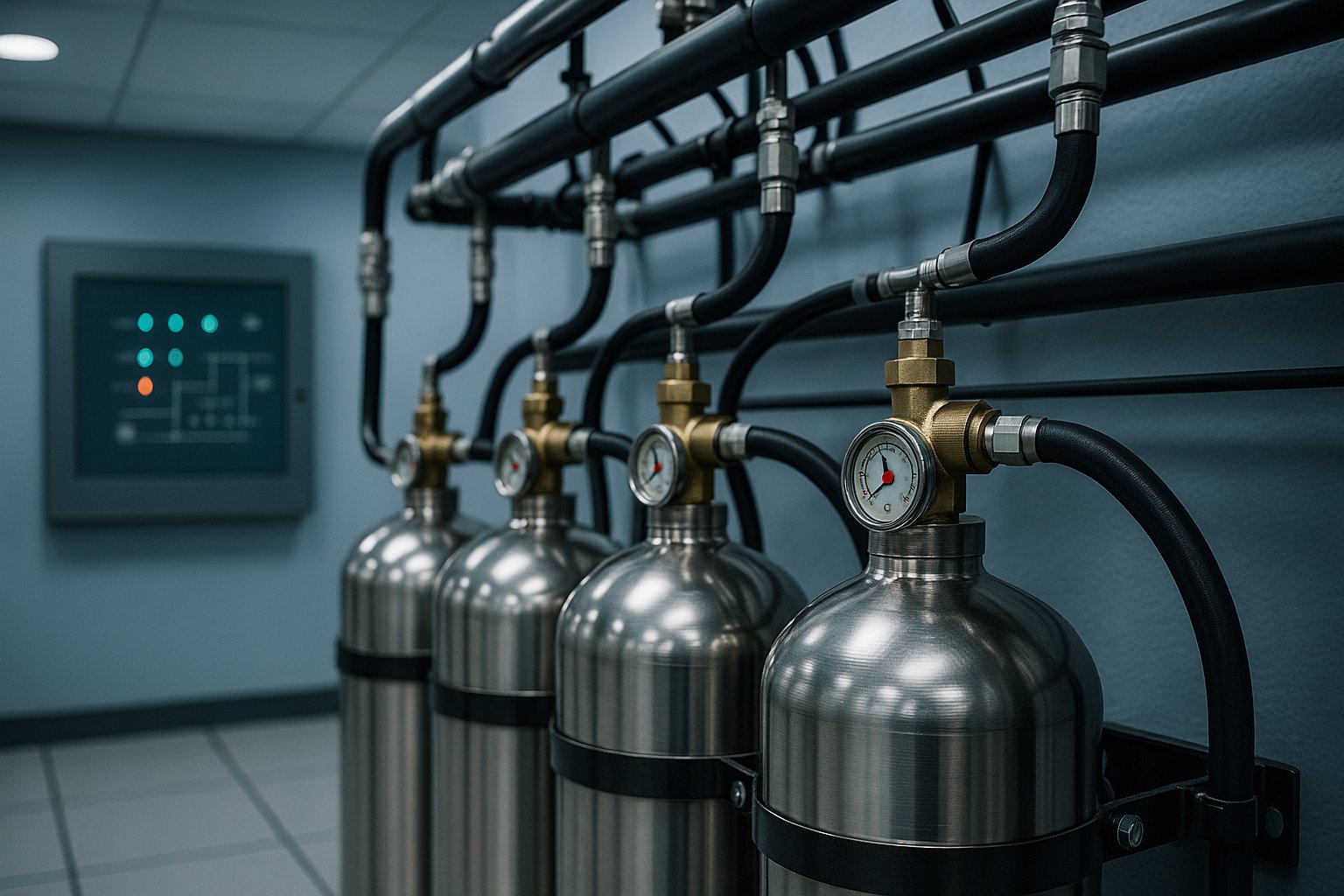
One of the most common compliance gaps in Southern California commercial properties involves special hazard systems. Fire suppression systems designed for specific high-risk occupancies that standard sprinkler coverage does not adequately address.
Clean agent systems protecting server rooms and electrical vaults. Foam suppression systems for warehouse facilities storing flammable liquids. Battery energy storage systems governed by NFPA 855, which has become one of the most actively enforced standards in California as EV charging infrastructure and commercial battery storage installations proliferate across the region.
Most specialty fire contractors do not design and install special hazard systems. Most special hazard contractors do not handle sprinklers and alarms. For a property manager with a mixed-use commercial building that includes a restaurant tenant, a data closet, and an EV charging station in the parking structure, that means three separate vendor relationships. Or one contractor who covers all of it.
The engineering depth required for special hazard work is exactly where regional contractors with in-house design capability pull away from generalist vendors. It is also where the questions about whether a regional contractor can handle complex work get answered directly: a 40-year design-through-installation track record across churches, schools, hospitals, warehouses, and restaurants is not a small-project resume.
Frequently Asked Questions
What fire protection systems does a full-service contractor in Southern California cover? Alternative Fire Protection Service covers all of these under a single contract, eliminating the need to coordinate separate vendors for each system type.
How do AHJ requirements differ across Southern California counties? Each county and municipality in Southern California applies its own amendments and enforcement priorities on top of state and national fire codes. AHJs in Riverside and San Bernardino Counties have their own permit submission requirements, inspection protocols, and current enforcement focuses. A contractor with established working relationships in those specific jurisdictions can anticipate what local inspectors will flag, reducing re-submission delays and deficiency notices that add cost and timeline risk to your project.
What does NFPA 855 mean for my commercial building? NFPA 855 is the standard for the installation of stationary energy storage systems, the regulation that governs battery storage systems and EV charging infrastructure in commercial facilities. As these installations become more common across Southern California commercial and industrial properties, AHJs are actively enforcing NFPA 855 compliance. If your building has or is adding battery storage or large-scale EV charging, your fire protection contractor should be evaluating your suppression and detection coverage against these requirements now, not after an inspection flags a deficiency.
How do I know if my existing fire protection systems are still code-compliant? Code compliance is not a one-time status. It requires ongoing inspection, testing, and maintenance on schedules defined by NFPA standards and your local AHJ. A compliance assessment from a full-lifecycle contractor will review your current system documentation, identify any overdue inspections or maintenance items, flag any code changes that affect your specific occupancy, and produce a clear picture of where your portfolio stands. Alternative Fire Protection Service offers free compliance assessments for commercial properties in its service area.
Can one contractor really handle design, installation, and inspections for a multi-site portfolio? Yes. And for multi-site property managers, it is the model that eliminates the coordination gaps that create compliance risk. When one contractor owns every phase of fire protection across all your locations, there is no handoff between design and installation, no gap between installation and ongoing service, and no situation where a deficiency falls through the cracks because two vendors each assumed the other one was tracking it. A single point of contact with unified compliance documentation across the portfolio is both operationally simpler and structurally safer.
The Right Contractor Changes the Compliance Equation
Fire protection compliance in Southern California is not getting simpler. NFPA standards continue to evolve. California's state amendments add a layer that out-of-region contractors routinely underestimate. Local AHJ enforcement is active and getting more rigorous. And the wildfire risk environment that defines this region demands that suppression systems be designed and maintained for the actual conditions they may face. Not just the conditions a generic code minimum assumes.
For commercial and industrial property managers who are done managing three vendors to cover what one accountable contractor should own, the question is not whether a full-lifecycle model is worth pursuing. The question is whether the contractor you are talking to has the 40 years of local design-through-inspection depth, the in-house fabrication capability, and the AHJ relationships across four counties to actually deliver it.
Alternative Fire Protection Service has been doing exactly this work in Southern California since 1987. Schedule a free compliance assessment for your property and get a clear picture of where your systems stand. And what it looks like to have one contractor own the outcome.
Schedule your free compliance assessment or request a turnkey fire protection quote at alternativefire.com.
Research sources8
Live web research informed this article. These are the sources it drew on.
- Our Markalternativllc.com
- Alternativ | Brussels - Facebookfacebook.com
- Alternativ: Renovation, fitting out of your offices or workspacesalternativ.be2025-11-13
- ALTERNATIV | Retail Apparel and Fashionlinkedin.com
- About Alternative | 20+ Years of Agile Digital Innovationsalternative.agency
- About Google Business Profile & brand profilesupport.google.com
- Brandfetch Alternative: Logo.dev's Image URL APIlogo.dev
- Create a brand profile - Customer Insightslearn.microsoft.com2024-11-22