Fire Protection Services for San Diego County Commercial Buildings
Managing commercial buildings in San Diego County means carrying a compliance obligation that does not pause between inspection cycles. Your fire protection systems are either maintained to current code or they are not, and the 2025 California Fire Code changes that took effect January 1, 2026 have moved the line on what current code actually requires.
"The biggest compliance gap in commercial fire protection is not a broken system. It is a contractor who has not told you what changed."
What the 2025 California Fire Code Means for Your Buildings
California began enforcing the 2025 California Fire Code on January 1, 2026. For commercial property managers in San Diego County, the changes that matter most are not abstract regulatory updates. They are schedule changes and documentation requirements that affect what your contractor is obligated to do on your behalf right now.
Waterflow devices and tamper switches require semiannual functional testing. End-to-end signal transmission testing must occur annually.
For water-based fire protection systems, California adopted the 2023 edition of NFPA 25 with a compliance deadline of July 1, 2026 for antifreeze provisions. That deadline has passed. If your sprinkler contractor has not confirmed your antifreeze system compliance, that is a gap in your current program.
San Diego County added its own layer on top of state requirements. The County began charging fees for annual inspections and re-inspections on July 1, 2025. If your contractor's work triggers a re-inspection because of incomplete corrections or missed deficiencies, that fee comes to you, not to them, unless you have a contractor who explicitly owns that outcome.
Why Multi-Site Property Managers Face Compounding Risk
The compliance challenge in San Diego County is not simply that the rules are complex, but that most commercial property managers are managing that complexity across multiple buildings, with multiple vendors, and no single party accountable for the full picture.
Each vendor knows their own scope. None of them knows the other's findings. When the AHJ asks for a comprehensive compliance record, the property manager is the one assembling it from three separate sources, chasing documentation, and hoping nothing was missed.
The correction notice, when it comes, has the property owner's name on it. Not the contractor's.
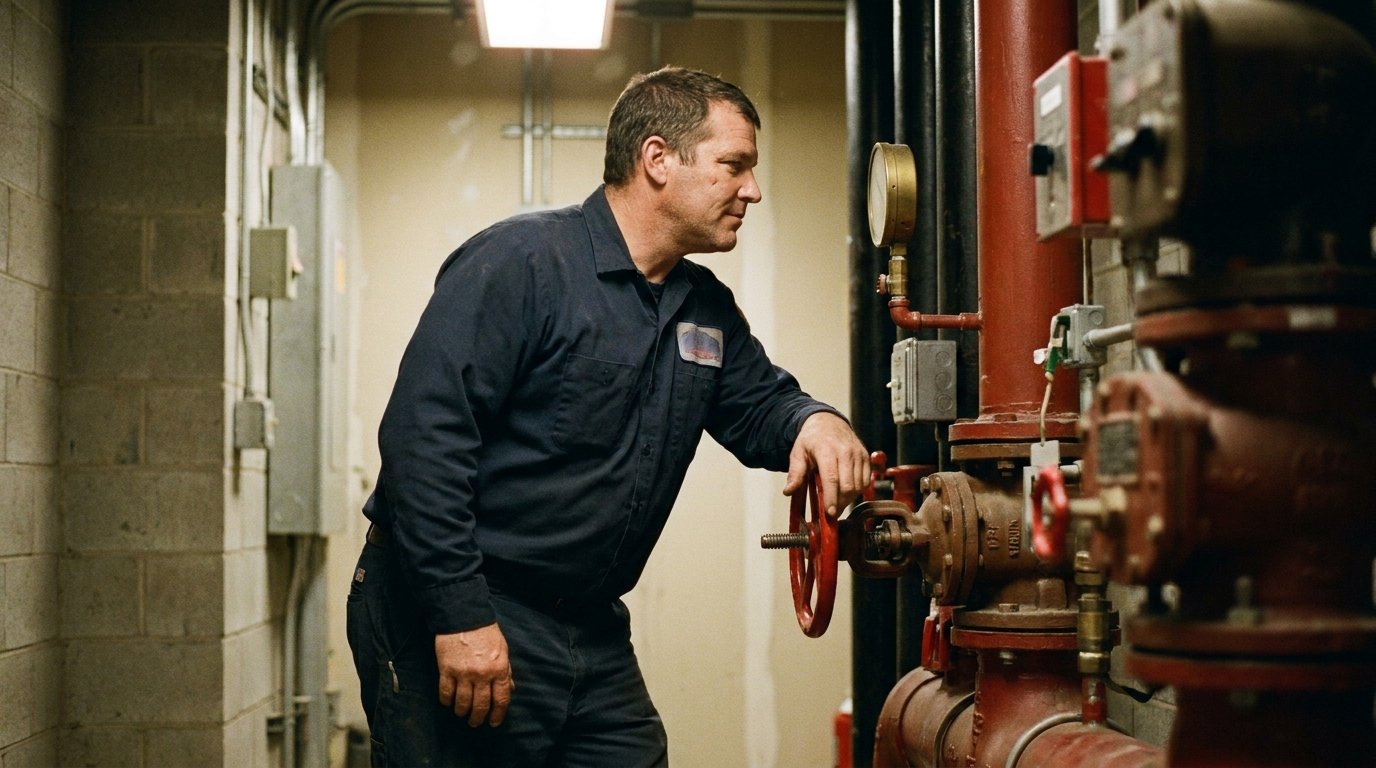
This is the structural problem that a single-contractor, full-lifecycle fire protection model solves: one inspection schedule, one documentation package, and one point of contact when the AHJ calls.
"When one contractor handles every system across every site, the compliance picture is unified. One schedule, one record, one call when the fire marshal asks."
The Specific Requirements for San Diego County Commercial Buildings
San Diego County's consolidated fire code establishes automatic sprinkler system requirements tied to building size and occupancy type. Commercial buildings in Group A, B, E, S, F, and M occupancy classifications require automatic sprinkler systems when the building exceeds 5,000 square feet or is more than 34 feet in height.
For property managers, this means that larger office buildings, retail spaces, warehouses, industrial facilities, and mixed-use properties are almost universally subject to ongoing sprinkler inspection and maintenance requirements under NFPA 25. The obligation is not optional and it does not expire between inspection cycles. The property owner's compliance program is continuous.
NFPA 25 is the baseline standard for inspection, testing, and maintenance of all water-based fire protection systems in California. A contractor performing annual or quarterly inspections on your sprinkler system is operating under that standard. What varies between contractors is whether they are current on California's specific adoption timeline, whether they understand your local AHJ's documentation requirements, and whether they are proactively flagging the changes that affect your buildings rather than simply executing the prior year's scope.
For San Diego County specifically, a fire protection contractor who also serves Riverside, Orange, and San Bernardino Counties brings a practical advantage. Each county AHJ has different enforcement timelines, different documentation formats, and different re-inspection fee structures. A contractor with active accounts across all four counties has jurisdictional fluency that a single-county or national contractor cannot replicate from a distance.
What a Full-Lifecycle Fire Protection Contractor Actually Covers
The term 'fire protection services' covers a wide range of scope, and the difference between a vendor who handles one system type and a contractor who handles the full lifecycle matters significantly for commercial property managers.
A fire protection contractor who only inspects your system is not the same as one who can design, install, repair, and certify it.
A full-lifecycle fire protection contractor for San Diego County commercial buildings should be capable of:
This matters because a contractor who only performs inspections cannot identify a design deficiency, only flag it for someone else to fix.
They are layered programs with quarterly, semiannual, and annual testing requirements across different system components. A contractor managing your full inspection calendar prevents missed test dates and the re-inspection fees that follow.
AHJ coordination and documentation. The paperwork that satisfies the San Diego County fire marshal is not the same format that satisfies the Riverside County AHJ. A contractor with direct familiarity with your local AHJ's requirements delivers documentation that passes review the first time, rather than triggering a correction notice for missing or improperly formatted records.
Deficiency repair and corrective work. When an inspection finds a deficiency, a full-lifecycle contractor can correct it without a separate service call to a different vendor. The inspection finding and the repair are handled by the same team, which closes the correction loop faster and reduces the window of non-compliance.
5-year certifications and Title 19 compliance. California's Title 19 regulations require on-site retention of ITM records for five years. For multi-site property managers, maintaining those records across multiple buildings and multiple system types is an operational burden that a managed compliance program absorbs.
How to Evaluate a Fire Protection Contractor for Your San Diego County Portfolio
Not every contractor who offers fire protection services in San Diego County is equipped to serve a multi-site commercial portfolio. When evaluating contractors, the questions that matter most are not about price. They are about accountability and scope.
Does the contractor hold a California State Fire Marshal license and a C-16 Fire Protection Contractor license from the California Contractors State License Board? These are the baseline credentials for performing fire protection work in California, and they should be confirmed before any other evaluation.
Does the contractor have active accounts across the counties where your buildings are located? A contractor based in the Inland Empire with accounts in San Diego, Orange, Riverside, and San Bernardino Counties has demonstrated the capacity to manage multi-county compliance, not just the intention to.
Can the contractor provide documentation in the format your specific AHJ requires, within a defined turnaround time? Inspection documentation that arrives three weeks after the inspection is documentation that cannot protect you when the fire marshal calls the following week.
Does the contractor offer a single point of contact for all system types, or will you be coordinating between separate technicians for sprinklers, alarms, and suppression? The coordination overhead is where compliance gaps form, and it falls on the property manager unless the contractor's model eliminates it by design.
Frequently Asked Questions
What fire protection inspections are required for commercial buildings in San Diego County? Inspection frequencies vary by system component, with some requiring quarterly checks, others semiannual testing, and annual comprehensive inspections. The specific schedule depends on your building's occupancy type and installed systems.
When did San Diego County start charging re-inspection fees? San Diego County began charging fees for annual inspections and re-inspections on July 1, 2025. If your fire protection contractor's corrections are incomplete and a re-inspection is required, the fee is assessed against the property owner, not the contractor. Choosing a contractor who explicitly owns the re-inspection outcome protects you from that exposure.
Does the 2025 California Fire Code affect my existing sprinkler system? Yes. The 2025 California Fire Code adopts the 2023 edition of NFPA 25, which includes updated antifreeze provisions with a compliance deadline of July 1, 2026. If your building has an antifreeze sprinkler system and your contractor has not confirmed compliance with the updated standard, you may have an open deficiency. A fire protection contractor current on the 2025 code adoption timeline can audit your system against the new requirements.
Yes, and for multi-site commercial property managers it is the most practical structure. A single contractor covering all system types under one agreement eliminates the coordination overhead of managing separate vendors, unifies your compliance documentation, and creates one accountable party for every deficiency finding across every building in your portfolio.
How do I know if my current fire protection contractor is current on California code changes? Ask them directly what the 2025 California Fire Code changes mean for your specific buildings. A contractor who cannot answer that question specifically is not current on the code your buildings are subject to right now.
The Standard Your Buildings Deserve
Fire protection compliance for commercial buildings in San Diego County is not a once-a-year event managed by whoever shows up for the annual inspection. It is a continuous program that requires a contractor who knows your systems, knows your AHJ's requirements, and owns the outcome when something needs to be corrected.
Alternative Fire Protection Service provides single-contractor accountability from design through ongoing compliance for commercial and industrial properties across San Diego, Orange, Riverside, and San Bernardino Counties. Based in Lake Elsinore, the team carries direct AHJ familiarity across the Inland Empire and surrounding counties, delivers NFPA-compliant, fully managed fire safety for commercial and industrial properties, and handles every system type under one accountable relationship.
If your current vendor has not told you what the 2025 California Fire Code changes mean for your buildings, that conversation needs to happen before your next inspection, not after your next correction notice.
Request a compliance assessment for your San Diego County properties
#AlternativeFireProtection #SoCalFireSafety #FireProtectionCA #CommercialFireCompliance #InlandEmpireFire
Research sources8
Live web research informed this article. These are the sources it drew on.
- 2023 CONSOLIDATED FIRE CODEsandiegocounty.gov
- County Fire Marshal - County of San Diego (Beta)beta.sandiegocounty.gov2026-03-10
- Fire Sprinkler System Maintenance | Requirements & Schedulevfsfire.com2026-08-13
- SEC. 362.5. SAN DIEGO COUNTY FIRE AUTHORITY.codelibrary.amlegal.com2011-01-01
- About the Fire Marshal Program - County of San Diegosandiegocounty.gov2025-05-06
- SEC. 96.1.001. ADOPTION OF COUNTY AMENDMENTS TO THE ...codelibrary.amlegal.com2022-01-01
- NFPA 25 Sprinkler Inspection Requirements in LA Metro | Up To Codeuptocode.build2026-03-15
- San Diego Fire Code Compliance: 2026 Commercial Guidefirecompliancehub.com2026-04-22