How to Pass Fire Sprinkler Inspection in California
The inspection your contractor completed last year might not count. California does not just require someone to show up and look at your sprinklers. It requires specific forms, specific test frequencies, and documentation forwarded to the right authority. Miss any piece of it and you are out of compliance, even if every sprinkler head works perfectly.
Here is exactly what the state requires, and how to make sure your next inspection holds up.
What California Code Actually Requires
California's sprinkler inspection framework is built on two layers. The first is Title 19, California Code of Regulations, which sets the statewide baseline for fire system inspection, testing, and maintenance. The second is NFPA 25, 2013 California Edition, which Title 19 adopts and which defines the specific tasks and frequencies your contractor must follow for water-based fire protection systems.
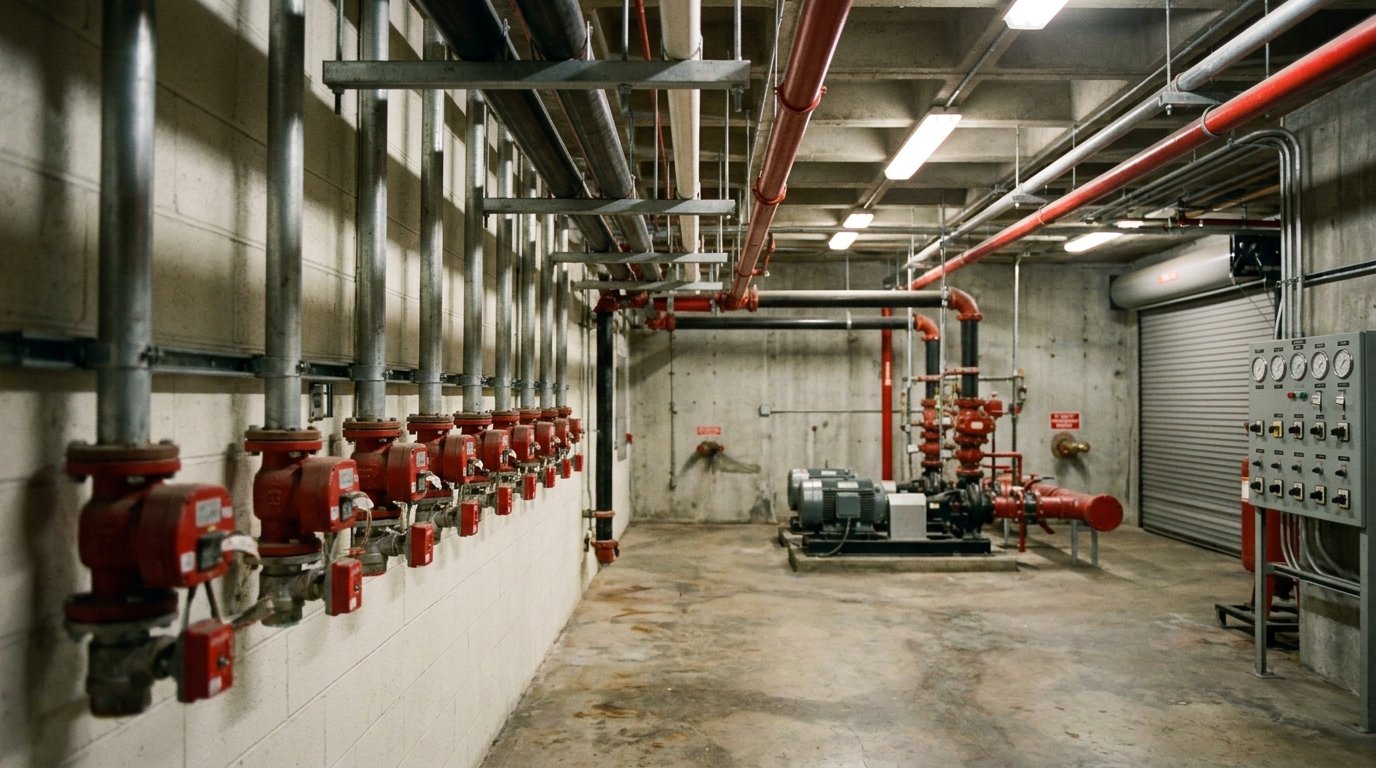
This is not a simple annual checkbox. Title 19 Article 4 establishes inspection and testing frequencies that vary by component. Gauges and certain valves require quarterly attention. Sprinkler heads, exposed piping, hangers, and braces require annual inspection. Select components and concealed spaces require a five-year internal inspection and testing cycle. If your current contractor is only showing up once a year and handing you a generic report, you are likely missing required quarterly items and your five-year cycle may never have been scheduled at all.
Single-contractor accountability from design through ongoing compliance is not a convenience. In California, it is the difference between documentation that holds up and documentation that does not.
The 2026 edition of NFPA 25 is now the active baseline standard nationally, and California's adoption timeline and AHJ amendments are evolving. Property managers with sites across multiple Southern California counties should confirm with their contractor that current inspection procedures reflect the most current enforceable version in each jurisdiction, because what applies in Riverside County may differ from what an Orange County AHJ enforces.
The AES Forms Requirement: Where Most Properties Fall Short
This is the piece that catches property managers off guard. California requires that all inspection, testing, and maintenance activities for automatic extinguishing systems be recorded on official Automatic Extinguishing Systems forms issued by the State Fire Marshal. These are not optional. They are not interchangeable with a contractor's own report template. If your inspection records are not on the correct AES forms, they do not satisfy California code regardless of how thorough the physical inspection was.
For wet pipe sprinkler systems, the required forms are specific. AES 2.1 covers quarterly and annual inspection, testing, and maintenance. AES 2.2 covers the five-year cycle and must be both retained on site and forwarded to the authority having jurisdiction. AES 1 is the cover sheet that accompanies the package. Dry pipe systems, pre-action systems, and deluge systems each have their own designated AES form series. If your contractor is not using these forms, the work does not count as a code-compliant inspection in California.
This is the documentation gap that creates real liability for property managers. You paid for an inspection. Your contractor did the work. But if the paperwork is on a proprietary template instead of the State Fire Marshal's AES forms, you do not have a compliant record. When the AHJ walks your site or an insurer requests your maintenance history, that distinction matters.
Who Can Legally Perform a Code-Compliant Inspection
Not every contractor who can look at a sprinkler system can legally perform a code-compliant inspection in California. The inspection must be performed by a contractor who holds the appropriate California State Fire Marshal licensing for the system type being inspected. For water-based fire protection systems, that means a licensed fire protection contractor operating under the appropriate C-16 or related classification, depending on the scope of work.
This matters for multi-site property managers because it is easy to accumulate vendors over time, some of whom may not hold the right credentials for every system type in your portfolio. A general maintenance contractor who checks sprinkler heads as part of a broader facilities contract is not performing a code-compliant NFPA 25 inspection. The inspection must be performed by a properly licensed fire protection contractor who is specifically qualified for water-based systems and who understands the AES documentation requirements.
The only inspection that protects you is one performed by the right contractor, on the right schedule, on the right forms, forwarded to the right authority.
For industrial and commercial properties in Riverside, San Bernardino, Los Angeles, and Orange Counties, the authority having jurisdiction varies. Riverside County Fire, CAL FIRE units, and individual city fire marshals all operate with their own inspection expectations and local amendments. A contractor with direct AHJ relationships in the Inland Empire brings a practical compliance advantage that a national contractor dispatching from outside the region simply cannot replicate. Knowing what a specific AHJ is currently writing deficiencies for is not something you learn from a manual. It comes from working in that jurisdiction regularly.
The Multi-Site Coordination Problem
For property managers overseeing more than one building, the documentation challenge compounds quickly. Each site has its own inspection schedule, its own AES form set, its own AHJ, and its own system types. A portfolio that includes a warehouse in San Bernardino, a light industrial complex in Lake Elsinore, and a mixed-use building in Orange County is operating under three different fire authorities, potentially with different local amendments to the same base code.
Most property managers handle this by accumulating multiple contractors. One for sprinklers. One for alarms. Each of those relationships produces its own documentation, on its own schedule, in its own format. Coordinating them to ensure nothing falls through the inspection calendar is a part-time job that property managers are quietly absorbing into their regular workload.
NFPA-compliant, fully managed fire safety for commercial and industrial properties means one inspection calendar, one documentation standard, and one accountable contractor across every site in your portfolio.
The alternative is a single fire protection contractor who covers every system type under one managed program. That means one inspection calendar, one documentation standard, one contact when the AHJ calls, and one accountable relationship if something is missed. For multi-site operators across Southern California, consolidating fire protection under a single contractor is not just operationally cleaner, but is the structure most likely to keep every site compliant without the property manager having to track it themselves.
What Happens When Records Do Not Hold Up
The consequences of a failed inspection or missing documentation are not abstract. An AHJ that finds records not on AES forms, or that finds quarterly inspections were never performed, can issue a notice of deficiency requiring immediate correction and re-inspection. In occupied commercial buildings, that can mean operational disruption, reinspection fees, and in some cases a compliance timeline that affects your insurance coverage.
California's wildfire environment adds pressure on top of the baseline code requirements. With roughly 1.28 million at-risk properties carrying an estimated $850 billion in replacement cost value exposed to wildfire statewide, insurers are scrutinizing fire system maintenance records more carefully than they were even two years ago. A property with clean, current, AES-documented inspection records is a materially different insurance risk than one with a folder of contractor templates and a gap in the five-year cycle. In a hard insurance market, that documentation gap can affect whether you get coverage renewed and at what premium.
The NFPA 25, 2026 edition is the active national baseline for water-based system inspection and maintenance. Staying current across these overlapping code cycles is not something a property manager should have to track manually.
Frequently Asked Questions
How often does a commercial fire sprinkler system need to be inspected in California? The frequency depends on the component. California requires quarterly checks for certain gauges and valves, annual inspections of sprinkler heads, exposed piping, and hangers, and a five-year internal inspection cycle for selected components. Title 19 Article 4 defines the full schedule, and your contractor must follow it to produce a code-compliant record.
What are AES forms and do I really need them? Yes. AES forms are official Automatic Extinguishing Systems forms issued by the California State Fire Marshal. California code requires that all inspection, testing, and maintenance of automatic extinguishing systems be recorded on these specific forms. A contractor's own report template does not satisfy the requirement. Wet pipe sprinkler systems require AES 2.1 for quarterly and annual work and AES 2.2 for the five-year cycle, with the latter forwarded to the AHJ.
Can any licensed contractor perform a code-compliant fire sprinkler inspection in California? No. The inspection must be performed by a contractor holding the appropriate California State Fire Marshal licensing for the system type.
What should I do if my current inspection records are not on AES forms? Contact a licensed fire protection contractor to assess your documentation and schedule the required inspections on the correct forms. The gap in your records is a compliance issue that needs to be corrected before your next AHJ inspection. Do not wait for the AHJ to find it.
Does one contractor have to handle all my fire systems, or can I use separate vendors? You can use separate vendors, but doing so creates coordination risk across inspection schedules, documentation formats, and system types.
The Right Contractor Makes This Straightforward
Passing fire sprinkler inspection in California comes down to three things: the right contractor, the right schedule, and the right documentation. All three have to be in place at the same time. A licensed fire protection contractor who knows the AES form requirements, follows the Title 19 inspection frequencies, understands local AHJ expectations across Southern California, and handles every system type under one managed program is not a luxury for a multi-site portfolio. It is the only structure that keeps compliance from becoming a recurring crisis.
Alternative Fire Protection Service provides single-contractor accountability from design through ongoing compliance for commercial and industrial properties across San Diego, Orange, Riverside, and San Bernardino Counties. The company is based in Lake Elsinore with direct AHJ relationships across the Inland Empire. If your current records would not hold up to an AHJ inspection tomorrow, that is the right place to start.
Schedule a Compliance Assessment
Research sources7
Live web research informed this article. These are the sources it drew on.
- Cal. Code Regs. Tit. 19, § 906.4 - Forms | State Regulations | US Lawlaw.cornell.edu2014-08-28
- Inspection, testing and maintenance requirements for existing fire ...gocodebook.com
- Automatic Fire Extinguishing Systems | OSFM - CA.govosfm.fire.ca.gov2026-07-17
- Orange County Fire Authorityocfa.org
- Cal. Code Regs. Tit. 19, § 904 - Required Inspection, Testing, and ...law.cornell.edu2014-08-28
- Inspections, Testing & Maintenance | Banning, CA - Official Websitebanning.ca.us2013-01-01
- Cal. Code Regs. Tit. 19, § 901 - Scope | State Regulations - LIIlaw.cornell.edu2018-03-03