NFPA Compliant Fire Sprinkler Contractor San Bernardino County
When a property manager in San Bernardino County searches for an NFPA compliant fire sprinkler contractor, they are usually looking for one of two things: a vendor who can pass an inspection, or a contractor who can keep them genuinely compliant. Those are not the same thing, and the gap between them is where most commercial fire protection problems quietly begin.
Here is what NFPA compliance actually requires, how San Bernardino County enforcement has shifted under the 2025 California Fire Code, and what to look for in a contractor who can handle all of it without you having to manage the details.
What Makes a Fire Sprinkler Contractor Truly NFPA Compliant
A contractor is NFPA compliant in San Bernardino County when its inspection, testing, and maintenance programs are built on NFPA 25, the Standard for the Inspection, Testing, and Maintenance of Water-Based Fire Protection Systems, and integrated with the current California Fire Code. NFPA 25 is not a design document. It governs what happens to a system after it is installed: how often components are inspected, what tests must be run, how deficiencies are documented, and what happens when occupancy or hazard loads change.
A contractor who can pass an inspection and a contractor who keeps you compliant year-round are doing fundamentally different work. Make sure you know which one you have.
For design and installation, NFPA 13 and CFC Section 903 govern the work. For everything after that, NFPA 25 is the standard. A contractor running annual inspections without being current on NFPA 25's required frequencies for control valves, gauges, waterflow devices, and tamper switches is not NFPA compliant regardless of what their report says.
The 2025 California Fire Code, effective January 1, 2026, adopted updated NFPA references including the 2023 edition of NFPA 25. That matters because the inspection frequencies and documentation requirements for some supervisory devices changed. If your current contractor has not communicated what those changes mean for your specific systems, that silence is worth questioning.
The Inspection Frequencies Your Contractor Must Be Managing
NFPA 25 sets specific inspection intervals for critical components of every water-based fire protection system. Most property managers are not aware of how granular these requirements are, and most inspection-only vendors are not managing them at the frequency the standard actually requires.
Here is what the 2023 edition of NFPA 25 requires for a typical commercial or industrial sprinkler system:
Weekly or Monthly Control valves and backflow preventers must be inspected at frequencies that vary based on how they are secured or supervised. A valve that is only sealed requires weekly inspection. A locked valve requires monthly inspection. An electrically supervised valve requires quarterly inspection. Most property managers do not know which category their valves fall into, and many inspection contractors are not running the correct frequency.
Monthly System pressure gauges must be checked regularly to confirm water supply and system status are within acceptable parameters.
Quarterly
Annual Sprinkler heads, pipe hangers, seismic bracing, and the overall system condition require annual inspection. For most commercial buildings, the annual inspection is the one that triggers the AHJ documentation requirement.
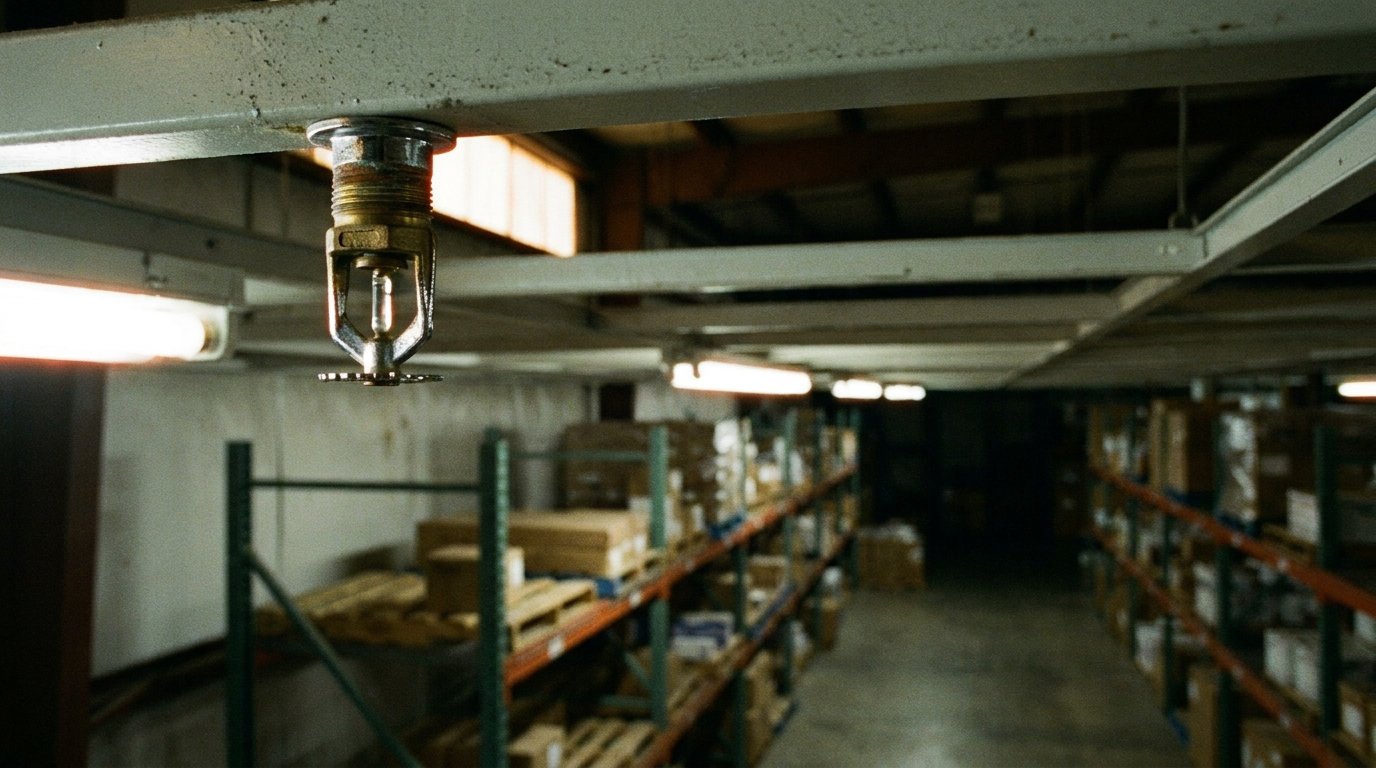
Five-Year Internal pipe inspections and obstruction investigations are required on a five-year cycle under NFPA 25. For high-bay warehouse and logistics facilities common in San Bernardino and Riverside Counties, this is particularly important because rack storage configurations and occupancy loads often change between five-year inspections.
Title 19 of the California Code of Regulations requires that inspection, testing, and maintenance records be retained on-site for a minimum of five years and be available for review by the AHJ on request. A contractor who does not deliver AHJ-ready documentation within a reasonable timeframe after each inspection is not meeting the full compliance requirement, regardless of whether the systems themselves passed.
What San Bernardino County AHJ Enforcement Looks Like Right Now
San Bernardino County fire officials are actively aligning enforcement with the 2025 California Fire Code and its updated NFPA references. The practical effect for property managers is that the bar for what constitutes a complete inspection record has moved. Documentation that satisfied the AHJ two years ago may not satisfy it today.
When the AHJ asks for records, corrected deficiencies, and proof of testing, you need a fire contractor who already knows the local playbook before they walk in the door.
Local amendments matter too. San Bernardino County AHJs have specific requirements around riser gauge specifications, valve hardware, and reporting formats that are layered on top of the state code. A contractor based in Los Angeles or San Diego who does not have active accounts across the Inland Empire is working from general knowledge rather than current local enforcement practice. That gap shows up in documentation, in how deficiencies are written up, and in how correction notices are resolved.
For multi-site property managers, the coordination problem compounds. If your sprinkler contractor, alarm vendor, and suppression company are all operating independently, no single party owns the integrated compliance picture. When the AHJ asks for a system-wide test result that crosses two of those contracts, the correction notice lands on your desk while your vendors point at each other.
What to Look for in a Contractor Serving San Bernardino County
When evaluating a fire sprinkler contractor for NFPA compliance in San Bernardino County, the questions that matter most are not about price. They are about accountability and local knowledge.
Does the contractor hold a California C-16 Fire Protection Contractor license? This is the baseline credential for fire sprinkler work in California. It is not optional, and it should be verifiable through the California Contractors State License Board before any work begins.
Is the contractor current on the 2023 edition of NFPA 25? Ask specifically whether their inspection protocols reflect the updated testing frequencies for waterflow devices, tamper switches, and gauge requirements. A contractor who cannot answer that question directly has not updated their program.
Can they deliver AHJ-ready documentation after each inspection? Title 19 requires five-year record retention. Ask what format the inspection reports are delivered in and how quickly they are available after service. If the answer is vague or measured in weeks, that is a gap.
Do they cover the full system? Sprinklers are one component. A contractor who only handles one of those systems leaves the rest to someone else, and the coordination gap is where compliance failures happen.
Do they have active accounts in San Bernardino County specifically? Local AHJ familiarity is a practical advantage, not a marketing claim. A contractor with ongoing accounts in San Bernardino County knows the current enforcement posture, the documentation formats the fire marshal expects, and the local amendments to the state code. One based in the Inland Empire with daily exposure to these jurisdictions is operating with information a distant contractor simply does not have.
Single-Contractor Accountability Across All Systems
The most common compliance gap in commercial and industrial fire protection is not a failing system. It is a fragmented vendor structure where no single contractor owns the full picture.
Each of those systems has its own NFPA compliance schedule, its own inspection documentation, and its own set of deficiencies that need to be corrected and closed before the AHJ is satisfied.
When those systems are spread across three or four vendors, the correction notice that arrives after a failed inspection does not have a clear owner. The sprinkler contractor says the alarm triggered a false waterflow test. The alarm contractor says the sprinkler valve was not in the correct position. The property manager is left coordinating between them while the AHJ's deadline runs.
Single-contractor accountability from design through ongoing compliance is not a convenience feature. It is the structural answer to the fragmentation problem that produces most commercial fire compliance failures.
From initial system design through fabrication, installation, ongoing service, and recurring NFPA-compliant inspections, the entire lifecycle is managed by one accountable contractor. That means one call resolves any deficiency across any system. It means AHJ-ready documentation is delivered without the property manager having to chase it. And it means the correction notice, if one ever arrives, has a clear owner who handles it.
Based in Lake Elsinore in Riverside County, the team has direct working familiarity with the AHJ relationships, local code amendments, and enforcement practices across the Inland Empire and surrounding counties. That is a different level of local knowledge than a national platform managing accounts from a distance.
As Paul Van Gaale, of Peter Van Gaale and Sons Construction in Murrieta, put it after more than thirty years working with the team: "From preliminary design to completion, they have always done an excellent job for our company and for our customers."
And from Michael Ellena, whose facility passed every inspection the first time: "Bryan came in and did what he said. No mess and passed all inspections for everything the first time."
Frequently Asked Questions
What is the difference between NFPA 25 and NFPA 13 for fire sprinkler compliance? NFPA 13 governs the design and installation of new fire sprinkler systems. NFPA 25 governs the ongoing inspection, testing, and maintenance of systems already in place. If your building has an existing sprinkler system, NFPA 25 is the standard your contractor must follow for recurring compliance. Both are referenced and enforced under the California Fire Code.
How often does a commercial fire sprinkler system need to be inspected in California? Inspection frequencies under NFPA 25 vary by component. Some supervisory devices require weekly or monthly inspection depending on how they are secured. Gauges require monthly checks. Full system inspections and waterflow tests are required annually. Internal pipe inspections are required on a five-year cycle. Title 19 requires that all inspection records be retained on-site for five years and be available to the AHJ on request.
Does the 2025 California Fire Code change anything for my existing sprinkler system? Yes. The 2025 California Fire Code, effective January 1, 2026, adopted updated NFPA references including the 2023 edition of NFPA 25. The updated standard includes revised testing frequencies for some supervisory devices such as waterflow alarms and tamper switches. If your contractor has not communicated what these changes mean for your specific systems, ask them directly whether their inspection protocols have been updated.
Yes, and for multi-site or multi-system properties it is the most practical compliance structure available. A single contractor who covers all system types eliminates the coordination gap between vendors, provides unified documentation for AHJ review, and owns accountability for every deficiency regardless of which system it originates in. Alternative Fire Protection Service covers the full range of commercial fire protection systems across San Bernardino, Riverside, Orange, and San Diego Counties under one contract.
What happens if my sprinkler system fails a San Bernardino County AHJ inspection? The AHJ issues a correction notice listing specific deficiencies that must be resolved before a re-inspection is scheduled. The property owner or manager is responsible for coordinating the corrective work and documenting that it has been completed. If the corrective work is incomplete at re-inspection, the AHJ in California now has authority under the 2025 California Fire Code to charge a reinspection fee. Having a single contractor who owns both the initial inspection and the corrective work eliminates the coordination gap and reduces re-inspection risk.
Conclusion
NFPA compliance in San Bernardino County is not a box that gets checked once a year. It is a continuous process of inspection, testing, documentation, and deficiency resolution that requires a contractor who is current on the right standards, familiar with local enforcement practice, and accountable for the full picture across every system type in your building.
If you manage commercial or industrial property in San Bernardino, Riverside, Orange, or San Diego County and want a single contractor to handle NFPA-compliant, fully managed fire safety from design through ongoing compliance, Alternative Fire Protection Service is built for exactly that.
Request a compliance assessment for your property
Research sources8
Live web research informed this article. These are the sources it drew on.
- NFPA 25 and Properly Maintaining a Sprinkler Systemnfpa.org2024-08-26
- A Guide to Key NFPA 25 Changes in the 2023 Editionblog.qrfs.com2026-02-08
- Choosing the Sample for NFPA 25 Fire Sprinkler Testingnfsa.org2023-08-17
- NFPA 25: Sprinkler Inspection, Testing & Maintenance Requirementsusmadesupply.com2026-07-14
- Chapter 5-1CALIFORNIA FIRE CODE, 2022 EDITIONcodepublishing.com
- Chapter 9 Fire Protection Systems: Fire Protection Systems, California Building Code 2016 (Vol 1 & 2) | UpCodesup.codes
- NFPA 25 Sprinkler Inspection Requirements | Up To Codeuptocode.build2026-03-30
- Chapter 9 Fire Protection and Life Safety Systems: Fire Protection and Life Safety Systems, California Building Code 2022 (Vol 1 & 2) | UpCodesup.codes