Fire Extinguisher Inspections Near Temecula: What You Need
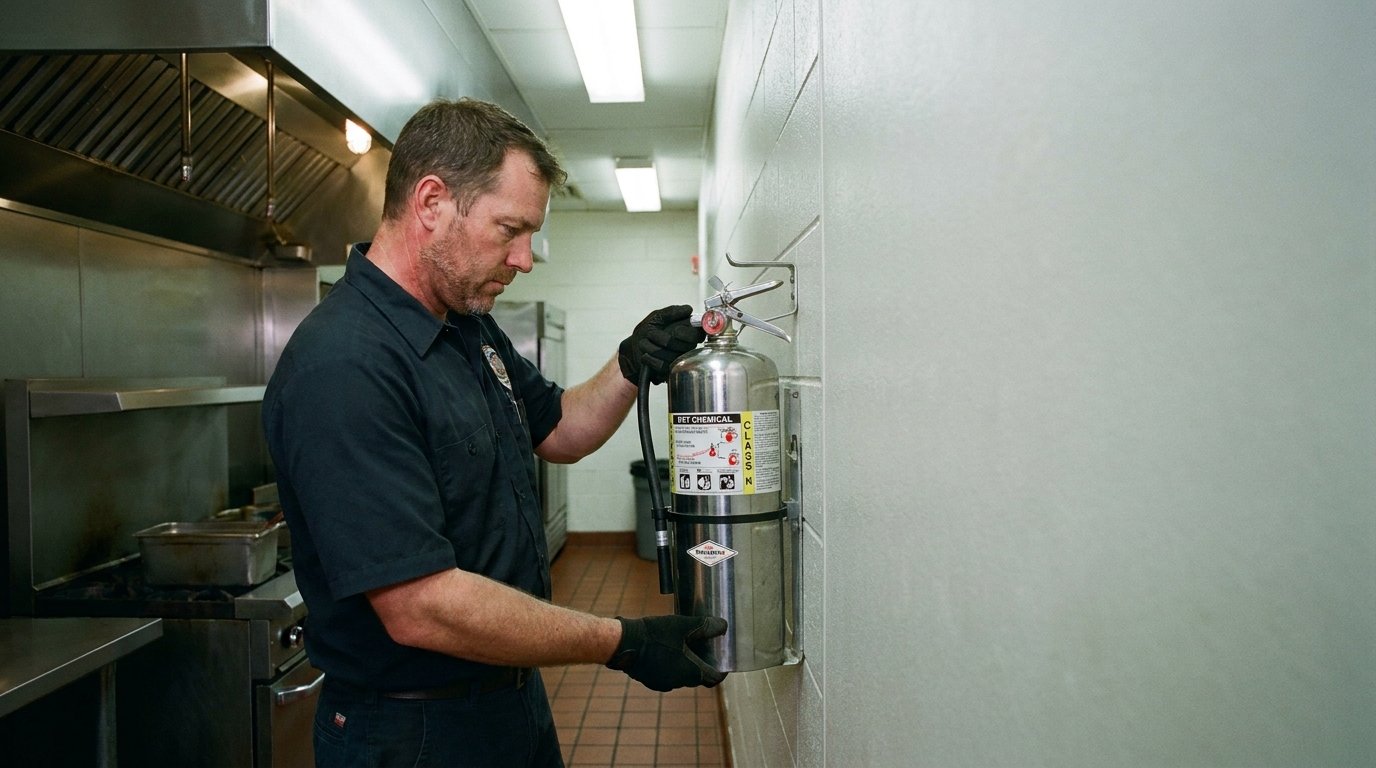
A fire extinguisher hanging on the wall is not the same as a compliant fire extinguisher program. For commercial and industrial property managers in Temecula, Murrieta, and Southwest Riverside County, the gap between those two things is exactly where liability lives.
What California Law and NFPA 10 Require of You
Every commercial property in California that provides portable fire extinguishers. Which is essentially every commercial property. Is subject to two overlapping sets of rules: the California Fire Code, enforced locally by the Riverside County Fire Department and the relevant city fire authority, and ==NFPA 10==, the national standard for portable fire extinguishers.
Under NFPA 10, extinguishers must receive a formal annual maintenance inspection performed by a trained, qualified person. This is not a visual walkthrough. It is a documented procedure that includes verifying the correct extinguisher type for each hazard zone, confirming placement and travel distance compliance, checking mechanical condition and charge status, and recording the service in a way that creates a defensible paper trail. Beyond the annual inspection, the building owner or designated facility staff is responsible for monthly visual checks. And those checks must be documented, not just performed.
"A tag on the extinguisher is not an inspection record. An inspection record is what survives an AHJ audit or an insurance carrier's post-incident review."
Riverside County Fire Department has been actively enforcing fire code compliance across commercial occupancies in the Southwest County corridor, including Temecula and Murrieta. If your facility is audited and your documentation is incomplete, the liability lands on the property manager and owner. Not the vendor who last walked through.
Why 'Near Temecula' Is More Than a Convenience Factor
When you search for a fire extinguisher inspection service near Temecula, proximity matters for reasons beyond scheduling. Southwest Riverside County has a specific mix of commercial occupancies. Wine production facilities, light manufacturing, cold storage, logistics and distribution, hospitality, and retail centers. Each of which presents distinct fire hazard profiles that directly affect which extinguisher types are required and how they must be placed.
A Class K extinguisher in a commercial kitchen is not interchangeable with an ABC dry chemical unit in a warehouse. A CO₂ system serving an electrical room has different placement and inspection requirements than a standard wall-mounted extinguisher in a retail corridor. A contractor who does not know your occupancy type is not in a position to tell you whether your current extinguisher inventory is correctly specified. And a generic national service provider with no local presence is unlikely to flag those distinctions during a fast annual visit.
Local presence also means direct familiarity with the AHJ. The Authority Having Jurisdiction. And how Riverside County Fire enforces the code in practice. That familiarity is not a small thing. It is the difference between a first-time inspection passing and a re-inspection cycle that costs you time, money, and credibility with ownership.
What a Proper Annual Fire Extinguisher Inspection Actually Covers
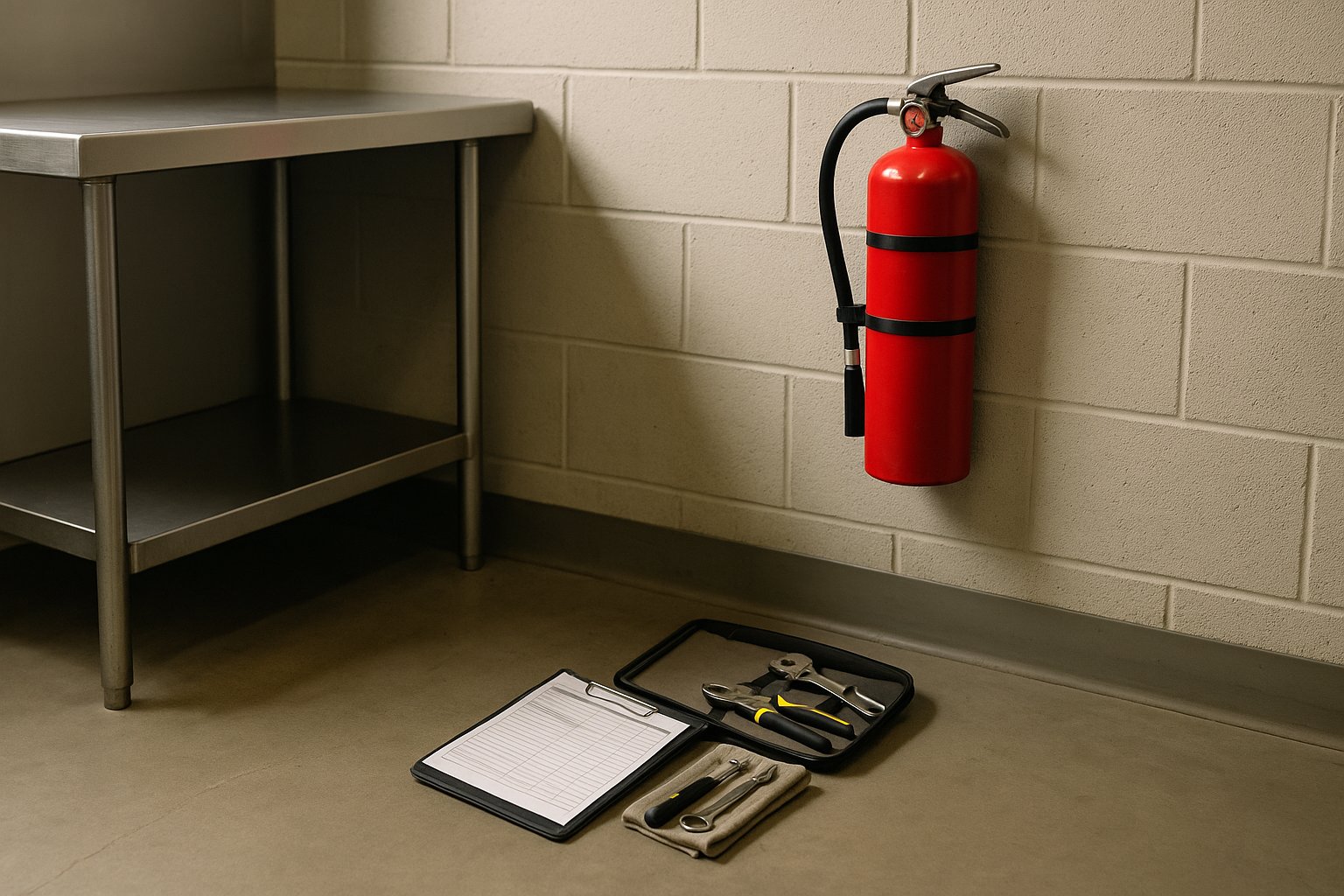
A compliant annual maintenance inspection under NFPA 10 is a structured procedure, not a tag swap. Here is what it must include for a commercial or industrial property in Southern California.
Hazard-type and extinguisher-type verification. The inspector confirms that each extinguisher is the correct agent class for its location. Ordinary combustibles require an ABC or BC-rated unit. Cooking oil and grease fires require a Class K wet chemical extinguisher. Flammable liquids in a manufacturing environment may require a CO₂ or dry chemical unit rated for Class B hazards. A mismatch here is a code violation and a genuine safety failure.
Placement and travel distance compliance. NFPA 10 specifies maximum travel distances to an extinguisher based on hazard class. 75 feet for ordinary hazard, 50 feet for extra hazard environments. If your facility layout has changed since the last inspection, coverage gaps may have opened without anyone noticing.
Physical condition and mechanical inspection. The inspector checks for corrosion, damage, blocked discharge, missing pull pins, and broken tamper seals. A unit that looks fine from across the room may fail a hands-on check.
Pressure and charge verification. Gauges are checked to confirm the unit is fully charged. Certain unit types require internal examination on a six-year cycle, and hydrostatic testing on a twelve-year cycle. Requirements that a one-time annual visit may not capture unless the contractor is tracking service history longitudinally.
Documentation. Every inspection must generate a written record attached to the extinguisher and retained in your facility's compliance file. The record must include the date, the inspector's name, and the findings. This documentation is what your insurance carrier and the AHJ will ask for. Not the tag itself.
[WARN] If your current extinguisher service provider cannot produce a complete inspection history for every unit on your property going back at least three years, you have a documentation gap that needs to be closed before your next insurance renewal or AHJ visit.
The Single-Contractor Advantage for Multi-Site Properties
For property managers overseeing more than one commercial location in Southwest Riverside County or across Southern California, fire extinguisher compliance is rarely the only fire protection obligation on your plate. You also have sprinkler systems, fire alarm panels, suppression systems in kitchens or server rooms, and special hazard systems in manufacturing or storage environments. Each with its own inspection schedule, its own documentation requirement, and its own code framework.
The most common compliance failure pattern is not a single missed inspection. It is the fragmentation that happens when three or four different vendors each own one piece of the system, and nobody owns the whole picture. One contractor handles extinguishers. Another handles sprinklers. A third handles alarms. When an AHJ inspection turns up a deficiency that crosses system boundaries. An alarm that should trigger a suppression system, a sprinkler zone that does not cover a new extinguisher placement. None of the three vendors is accountable for the gap.
^^ One contractor. Every system. One compliance record. That is the only model that eliminates the gaps that cause violations.
Alternative Fire Protection Service provides single-source accountability across every phase of fire protection. Design, fabrication, installation, maintenance, and inspections. For commercial and industrial properties across San Diego, Orange, Riverside, and San Bernardino Counties. That includes portable fire extinguisher inspection and maintenance for properties in Temecula, Murrieta, and the broader Southwest Riverside County corridor. With 40+ years of fire sprinkler design and installation expertise in Southern California and no subcontractor handoffs at any phase, there is always one point of contact who owns the compliance outcome for your entire facility.
What to Ask Any Fire Extinguisher Inspection Service Before You Hire Them
Not all inspection providers are equal, and the lowest-bid option frequently produces the thinnest documentation. Before you engage any contractor for fire extinguisher inspection service near Temecula, ask these questions directly.
Are you licensed and certified to perform NFPA 10 inspections in California? California requires fire extinguisher service technicians to hold a valid license through the State Fire Marshal's office. Ask for the license number and verify it.
Do you provide written documentation for every unit inspected? The answer should be yes, without hesitation. If the answer involves a verbal report or a tag-only record, that is not NFPA 10 compliant documentation.
Can you track and notify me of six-year internal examination and hydrostatic testing due dates? A contractor managing your extinguisher program longitudinally, not just annually, is a contractor who is actually protecting you.
Do you also handle sprinklers, alarms, and suppression systems? If you are managing a complex commercial facility, the answer to this question tells you whether you are hiring a vendor or a partner.
Are you familiar with Riverside County Fire Department's local enforcement priorities? A contractor who can answer this specifically. Not generically. Has the local presence that protects you at inspection time.
FAQs: Fire Extinguisher Inspection Near Temecula, CA
How often does a commercial fire extinguisher need to be inspected in California? Under NFPA 10 and the California Fire Code, portable fire extinguishers in commercial properties require a formal annual maintenance inspection performed by a qualified technician, with documented monthly visual checks conducted by the building owner or designated staff. Certain unit types also require internal examination every six years and hydrostatic testing every twelve years. Missing any of these intervals creates a compliance gap that can result in violations during an AHJ inspection.
What happens if my fire extinguishers fail a Riverside County inspection? If the Riverside County Fire Department or a local AHJ finds extinguisher deficiencies during an inspection, you may receive a notice of violation requiring corrective action within a specified timeframe. Depending on the severity, this can include fines, a requirement to remove the building from service until corrections are made, and complications with your commercial property insurance coverage. Working with a contractor who is already familiar with local enforcement priorities significantly reduces the risk of a first-time violation.
Can one contractor handle fire extinguishers and my sprinkler or alarm systems? Yes, and for most multi-system commercial properties, a single contractor handling all fire protection systems is the more reliable model. When one contractor owns the compliance record across extinguishers, sprinklers, alarms, and suppression systems, there are no handoffs between vendors and no gaps in accountability when an issue crosses system boundaries. Alternative Fire Protection Service provides full-lifecycle fire protection services across all system types for commercial and industrial properties in Southern California, including Temecula and Southwest Riverside County.
How do I know if my current extinguishers are the right type for my facility? Extinguisher type must match the hazard class present in each area of your building. A commercial kitchen requires a Class K wet chemical extinguisher near cooking equipment. A manufacturing floor with flammable liquids requires units rated for Class B hazards. A server room or electrical area typically requires a CO₂ or clean-agent unit. If you are not certain your current inventory is correctly specified for your occupancy type, a site assessment by a qualified contractor will identify any mismatches before they become violations.
What documentation should I keep for fire extinguisher compliance? You should retain a written inspection record for every extinguisher on your property, including the date of each annual inspection, the technician's name and license information, and the findings. Monthly visual inspection logs should also be maintained on-site. These records are what an AHJ or insurance carrier will request during an audit or after an incident. If your current service provider is not generating and filing this documentation for you, that is a gap worth closing immediately.
The Bottom Line: Compliance Is Only as Strong as the Record Behind It
A fire extinguisher on the wall is a starting point, not a compliance program. For commercial and industrial property managers in Temecula, Murrieta, and Southwest Riverside County, real NFPA 10 compliance means documented annual inspections, verified hazard-type matching, tracked service intervals, and a contractor who owns the outcome across every system on your property.
Alternative Fire Protection Service has been delivering exactly that for Southern California commercial and industrial properties since 1987. With 40+ years of fire sprinkler design and installation expertise, single-source accountability from design through ongoing inspection, and deep working relationships with AHJs across four counties, we are the contractor that property managers call when they need the answer to be right. Not just fast.
Schedule a free compliance assessment for your property today. We will review your current fire protection documentation, identify any gaps, and give you a clear picture of where you stand before the next inspection. Reach out to Alternative Fire Protection Service to get started.
Research sources 8
Live web research informed this article. These are the sources it drew on.
- Our Mark alternativllc.com
- Alternativ | Brussels - Facebook facebook.com
- Alternativ: Renovation, fitting out of your offices or workspaces alternativ.be 2025-11-13
- ALTERNATIV | Retail Apparel and Fashion linkedin.com
- About Alternative | 20+ Years of Agile Digital Innovations alternative.agency
- Brandfetch Alternative: Logo.dev's Image URL API logo.dev
- About Google Business Profile & brand profile support.google.com
- The Company alternativa.ind.br 2025-07-24